
Dioptase
| CuSiO |
| (OH) |
|
- Mohs hardness
- 5
- Refractive index
- 1.644–1.720
- Specific gravity
- 3.25–3.35
- Birefringence
- 0.051–0.053
- Dispersion
- 0.036
- Crystal system
- Trigonal
- Optical character
- Uniaxial
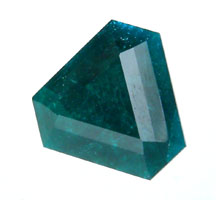
Dioptase is a popular collectors' mineral specimen and is smetimes cut into small emerald-like gems. The material is very soft to be worn as a ring-stone, but small specimens are sometimes mounted in pendants and brooches.
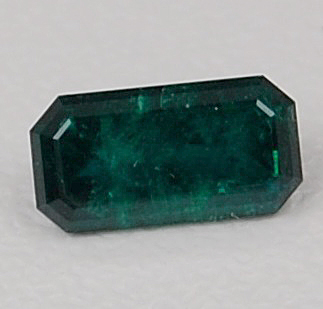
Colours
The colours of Dioptase on this site, from 6 graded photos. Choose a colour to see all of its photos.
Cuts
-
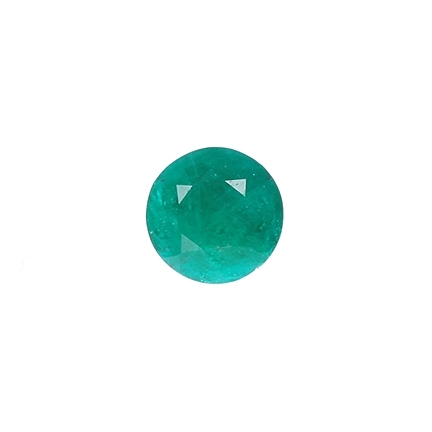
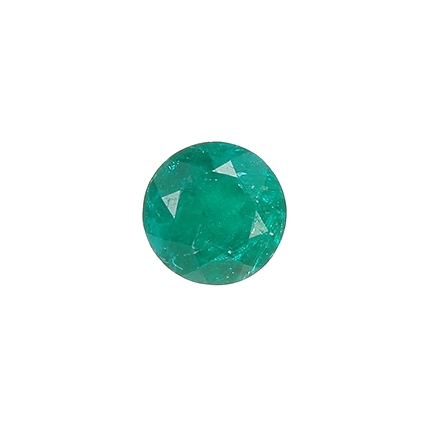 Round Brilliant
4 photos
-
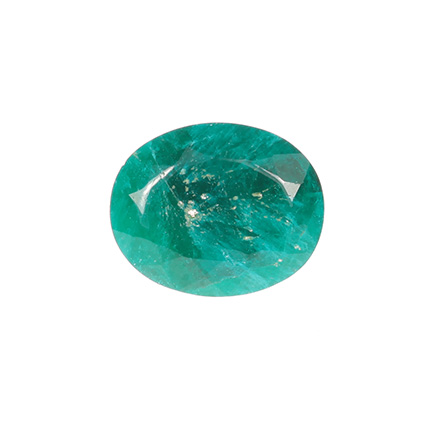 Oval Brilliant
2 photos
-
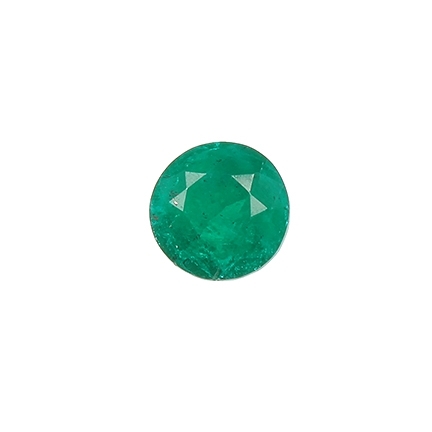 Round
2 photos
-
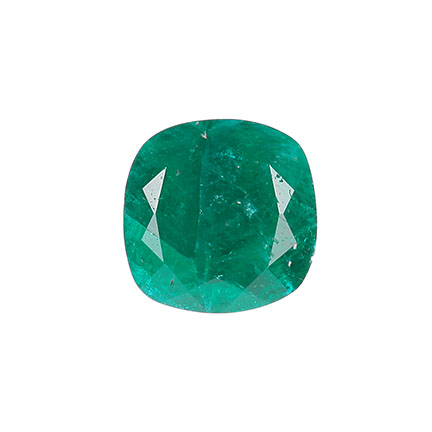 Square Cushion
2 photos
-
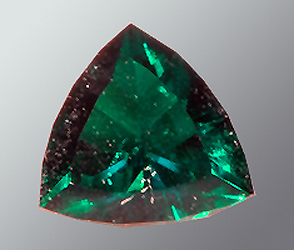
Trillion
2 photos
-
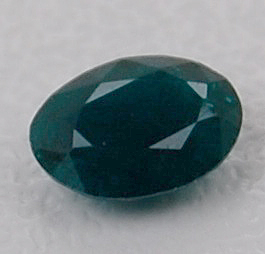 Oval
1 photo
-
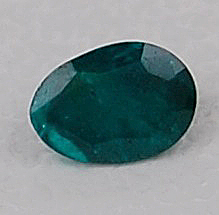 Pear
1 photo
-
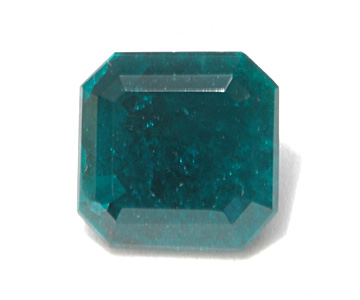 Square Brilliant
1 photo
Sizes
Weights of the 16 photographed Dioptase gems on this site, a guide to how readily it is found in larger sizes. The scale is logarithmic. Choose a bar to see those gems.
Have a larger Dioptase? Add a photo.
Identification notes
From the Gray Gem ID Database.
Dioptase is a popular collectors' mineral specimen and is sometimes cut into small emerald-like gems. The material is too soft to be worn as a ring-stone, but small specimens are sometimes mounted in pendants and brooches.
Name: Dioptase is named after Greek word for "view through" referring to the mineral's two cleavage directions that are visible inside unbroken crystals.
- Rarity
- Very Rare
- Chemical class
- Silicate
- Formula
- CuSiO₂(OH)₂ CuSi
- Critical angle (°)
- 37.5
- Dispersion (B–G)
- 0.036
- Doubling
- 0.019 mm per 1 mm depth (approx.)
- Electrical
- Pyroelectric
- Crystal class
- Trigonal Rhombohedral
Care
- Heat
- V- low
References (1)
- Phillips, W.R. and Griffen, D.T. (1981) Optical Mineralogy: The Nonopaque Minerals. San Francisco, W.H. Freeman and Co., 677 pp.
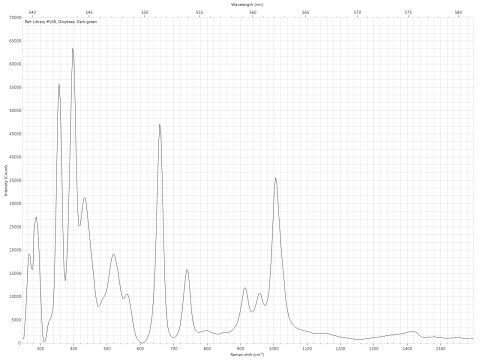
Reference spectra
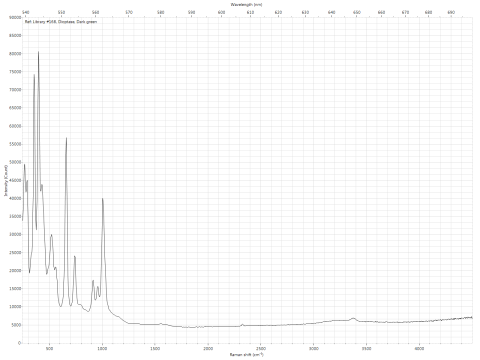
2 spectra of documented Dioptase reference stones (1 PL, 1 Raman). From the Gray Gem ID Database.
General information
| Chemical Formula |
|
|---|
Physical properties
| Mohs Hardness | 5, Blue Chart Gem Identification (2010) More from other references |
|---|---|
| Specific Gravity | 3.25 to 3.35, Blue Chart Gem Identification (2010) More from other references |
| Tenacity | Brittle, Gemstones of the world (2001) |
| Cleavage Quality | Perfect, Gemstones of the world (2001) More from other references |
| Fracture | Conchoidal, Gemstones of the world (2001) More from other references |
Optical properties
| Refractive Index | 1.644 to 1.720, Blue Chart Gem Identification (2010) More from other references |
|---|---|
| Optical Character | Uniaxial/+, Blue Chart Gem Identification (2010) More from other references |
| Birefringence | 0.051 to 0.053, Blue Chart Gem Identification (2010) DoublingMore from other references |
| Pleochroism | Weak; dark emerald green, light emerald green., Gemstones of the world (2001) More from other references |
| Dispersion | 0.036, Gemstones of the world (2001) More from other references |
Colour
| Colour (General) | Dark vivid bluish-green, Blue Chart Gem Identification (2010) More from other references |
|---|---|
| Causes of Colour | Green, Cu2+ in octahedral coordination, Pragmatic Spectroscopy For Gemologists (2011) |
| Transparency | Translucent, Blue Chart Gem Identification (2010) Usually translucentMore from other references |
| Lustre | Vitreous, Gemstones (2009) |
Fluorescence & other light emissions
| Fluorescence (General) | None, Gemstones of the world (2001) More from other references |
|---|
Crystallography
| Crystal System | Trigonal, Blue Chart Gem Identification (2010) More from other references |
|---|---|
| Habit | Prismatic or rhombohedral crystals, Gems, Sixth Edition (2006) More from other references |
Geological environment
| Where found: | Dioptase is found in the oxidized zones of some copper deposits., Gems, Sixth Edition (2006) |
|---|
Localities
4 of 4 localities mapped · dashed orange markers are approximate · compare with other gems on the map
| |||||||||||||||||||