
Scolecite
| CaAl |
| Si |
| O |
| · 3H |
| O |
- Mohs hardness
- 5–5.5
- Refractive index
- 1.512–1.523
- Specific gravity
- 2.20–2.23
- Birefringence
- 0.011
- Dispersion
- Strong
- Crystal system
- Monoclinic
- Optical character
- Biaxial
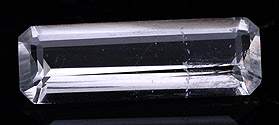
Scolecite forms pyroelectric and piezoelectric colourless to white slender crystals.
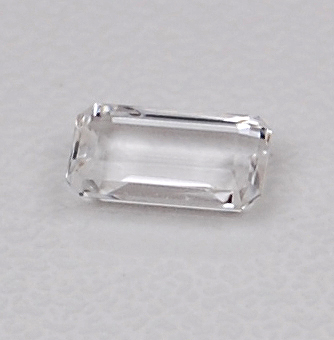
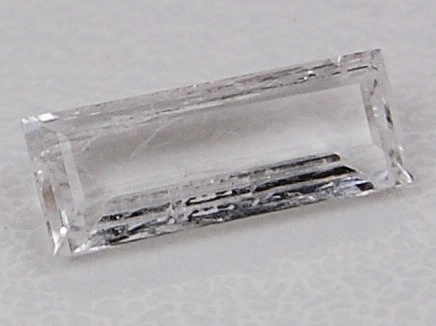
Colours
The colours of Scolecite on this site, from 3 graded photos. Choose a colour to see all of its photos.
Identification notes
From the Gray Gem ID Database: Zeolite, Scolecite.
Scolecite forms pyroelectric and piezoelectric colorless to white slender crystals.
Name: Scolecite is named after Greek "skolex" – worm, because the borax bead containing the mineral in some cases curls up like a worm in the blowpipe flame.
- Rarity
- Very Rare
- Chemical class
- Silicate
- Formula
- CaAl₂Si₃O₁₀•3H₂O
- Critical angle (°)
- 41.6
- Doubling
- 0.004 mm per 1 mm depth (approx.)
- Electrical
- Piezo- and pyroelectric
- Crystal class
- Domatic
Care
- Heat
- high
References (1)
- Anthony, J.W., Bideaux, R.A., Bladh, K.W. and Nichols, M.C. (1990–2003) Handbook of Mineralogy. Chantilly, VA, Mineralogical Society of America, 5 Vols.
Reference spectra
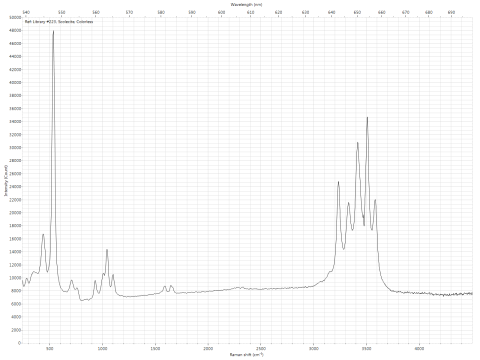
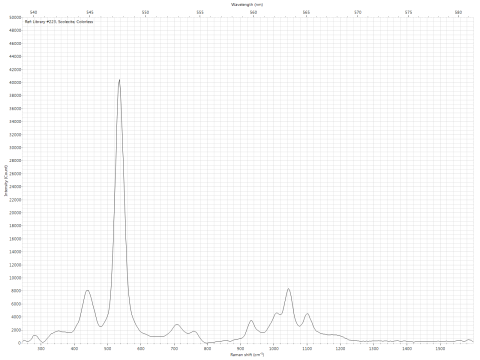
2 spectra of documented Scolecite reference stones (1 PL, 1 Raman). From the Gray Gem ID Database.
General information
| Chemical Formula |
|
|---|
Physical properties
| Mohs Hardness | 5 to 5.5, Gemmological Tables (2004) More from other references |
|---|---|
| Specific Gravity | 2.20 to 2.23, Gemmological Tables (2004) More from other references |
| Tenacity | Brittle, Handbook of mineralogy (2001) |
| Cleavage Quality | Perfect, Gems, Sixth Edition (2006) |
| Fracture | Uneven, Handbook of mineralogy (2001) |
Optical properties
| Refractive Index | 1.512 to 1.523, Gemmological Tables (2004) More from other references |
|---|---|
| Optical Character | Biaxial/-, Gemmological Tables (2004) More from other references |
| Birefringence | 0.011, Gemmological Tables (2004) More from other references |
| Dispersion | Strong, Handbook of mineralogy (2001) |
Colour
| Colour (General) | Colourless, white, Gemmological Tables (2004) More from other references |
|---|---|
| Transparency | Transparent,Translucent,Opaque, Gemmological Tables (2004) More from other references |
| Lustre | Vitreous,Silky, Handbook of mineralogy (2001) Silky when fibrous |
Fluorescence & other light emissions
| Fluorescence (General) | There may be a yellow to brown fluorescence, Gems, Sixth Edition (2006) More from other references |
|---|---|
| Fluorescence (Long-Wave UV) | SWLW yellow to brownGray Gem ID Database (2020) Data for Zeolite, Scolecite |
Crystallography
| Crystal System | Monoclinic, Gemmological Tables (2004) More from other references |
|---|---|
| Habit | Pseudotetragonal, Gems, Sixth Edition (2006) More from other references |
Geological environment
| Where found: | Scolecite occurs with other zeolites primarily as a cavity mineral in basalts., Gems, Sixth Edition (2006) More from other references |
|---|
Localities
2 of 2 localities mapped · dashed orange markers are approximate
| ||||||||||||