
Friedelite
| Mn |
| Si |
| O |
| (OH,Cl) |
|
- Mohs hardness
- 4–5
- Refractive index
- 1.627–1.663
- Specific gravity
- 3.06–3.19
- Birefringence
- 0.032–0.035
- Dispersion
- Nil
- Crystal system
- Monoclinic
- Optical character
- Uniaxial
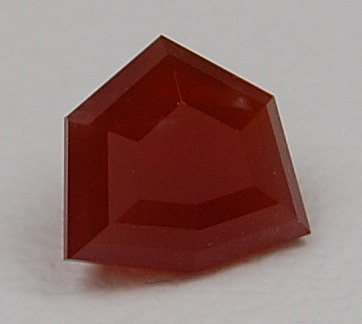
Friedelite is usually massive but may also form tabular crystals. Transparent rose-red to orange-red material has been faceted and cut into cabochons.
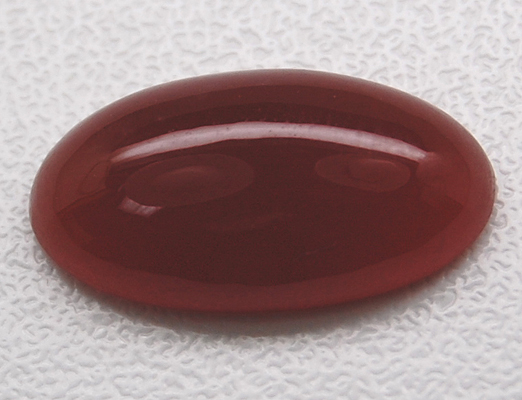
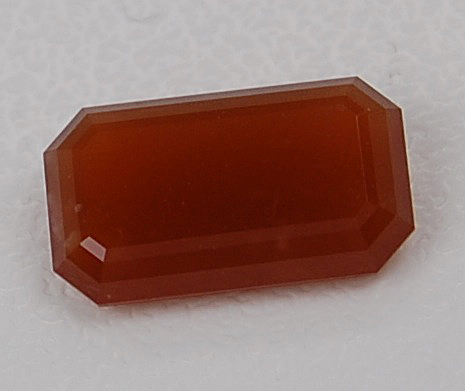
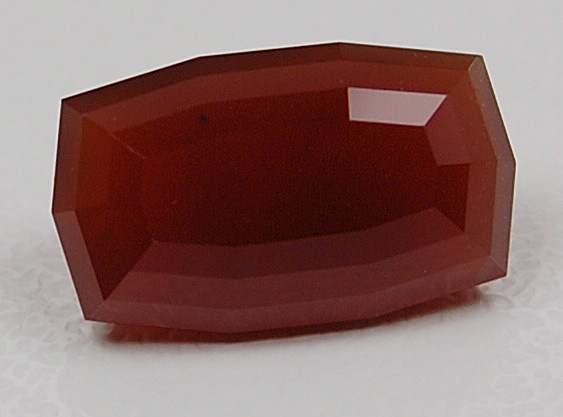
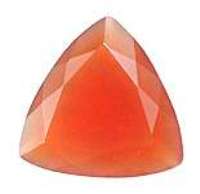
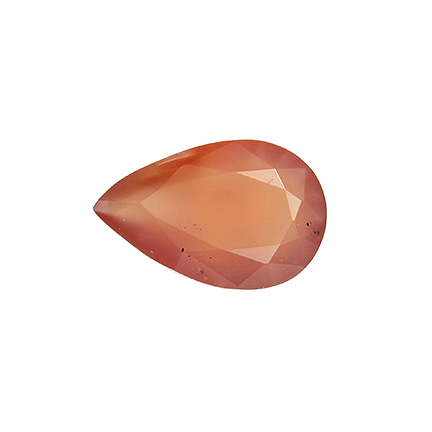
Colours
The colours of Friedelite on this site, from 4 graded photos. Choose a colour to see all of its photos.
Sizes
Weights of the 6 photographed Friedelite gems on this site, a guide to how readily it is found in larger sizes. The scale is logarithmic. Choose a bar to see those gems.
Have a larger Friedelite? Add a photo.
Identification notes
From the Gray Gem ID Database: Pyrosmalite, Friedelite.
Transparent rose-red to orange-red material has been faceted and cut into cabochons.
Name: Named by Emile Bertrand in 1876 in honor of the noted French chemist and mineralogist, Charles Friedel [1832–1899 Montauban, France], who was professor of chemistry at the Sorbonne. Friedel developed the Friedel-Crafts alkylation and acylation reactions with James Crafts in 1877, and attempted to make synthetic diamonds. His son Georges Friedel [1865–1933] also became a renowned mineralogist and who is well-known for Friedel's Law, which is used in X-ray diffraction calculations.
- Rarity
- Rare
- Chemical class
- Silicate
- Formula
- Mn²⁺₈Si₆O₁₅(OH,Cl)₁₀
- Critical angle (°)
- 38.1
- Doubling
- 0.013 mm per 1 mm depth (approx.)
- Crystal class
- Prismatic
Care
- Heat
- moderate
References (1)
- Anthony, J.W., Bideaux, R.A., Bladh, K.W. and Nichols, M.C. (1990–2003) Handbook of Mineralogy. Chantilly, VA, Mineralogical Society of America, 5 Vols.
General information
| Chemical Formula |
|
|---|
Physical properties
| Mohs Hardness | 4 to 5, Gemmological Tables (2004) More from other references |
|---|---|
| Specific Gravity | 3.06 to 3.19, Gemstones of the world (2001) More from other references |
| Cleavage Quality | Perfect, Gemmological Tables (2004) More from other references |
| Fracture | Uneven, Gemstones (2009) Tough |
Optical properties
| Refractive Index | 1.627 to 1.663, Gemmological Tables (2004) More from other references |
|---|---|
| Optical Character | Uniaxial/-, Gemmological Tables (2004) More from other references |
| Birefringence | 0.032 to 0.035, Gemmological Tables (2004) More from other references |
| Pleochroism | Nil, Gemstones (2009) |
| Dispersion | Nil, Gemstones (2009) |
Colour
| Colour (General) | Pink, red, brown, yellow, Gemmological Tables (2004) More from other references |
|---|---|
| Transparency | Translucent,Opaque, Gemmological Tables (2004) More from other references |
| Lustre | Vitreous, Gemstones (2009) |
Fluorescence & other light emissions
| Fluorescence (General) | Reddish, Gemmological Tables (2004) More from other references |
|---|---|
| Fluorescence (Short Wave UV) | Some specimens have shown green fluorescence, Gems, Sixth Edition (2006) |
| Fluorescence (Long-Wave UV) | Some specimens have shown yellow fluorescence, Gems, Sixth Edition (2006) |
Crystallography
| Crystal System | Monoclinic, Gemstones of the world (2001) Pseudo-trigonalMore from other references |
|---|---|
| Habit | Pseudohexagonal tablets, Gems, Sixth Edition (2006) More from other references |
Geological environment
| Where found: | Occur in metamorphosed manganese–iron deposits, Gems, Sixth Edition (2006) |
|---|
Localities
2 of 2 localities mapped · dashed orange markers are approximate
| |||||||||